
Lone Wolf Colony History
During World War I (1914–1918), more than 15 million people were killed and millions more were injured. Poison gas was among the weapons used during the conflict and caused serious injuries to many service members.
Some Pacific Telephone and Telegraph employees returning from military service had suffered the effects of poison gas exposure and were unable to obtain the hospitalization or continuing care they needed. In response, a committee from the Engineering Department of the Southern California Telephone Company, a subsidiary of Pacific Telephone and Telegraph, began arranging care and lodging for these convalescing veterans.
Shortly after World War I, Samuel Caldwell, an employee of the Southern California Telephone Company in Los Angeles, was diagnosed with tuberculosis. After completing treatment, he was advised to continue his recovery in a dry climate for an extended period.
Following this advice, Samuel filed a homestead claim on 160 acres at Dry Lake Flats in the Mojave Desert, an area known for having one of the driest climates in California.

Samuel Caldwell 1922
Short of funds, Samuel understood that he would be living on the property for an indefinite period and needed a plan for the future.
Before merging with the Southern California Telephone Company, Samuel and many of his coworkers had worked for the Home Telephone and Telegraph Company in Los Angeles. They were a close-knit group.
In 1917, Samuel shared an idea with his coworkers. He proposed that, with modest development, the property could become a health ranch where other telephone company employees with lung disorders could convalesce. He offered the property and its associated rights on the condition that he be allowed to remain there and receive support during his recovery.
His coworkers supported the proposal, and together they began promoting the idea of establishing a health ranch for company employees.
Samuel’s earliest supporters, primarily employees from outside plant departments, raised funds to construct a small building on the property. Historical records described the building as a “shack.”
Samuel and another tuberculosis patient, Frances Weisenborn, stayed in the cabin. Weisenborn remained at Lone Wolf Colony for a record 656 days.
Samuel and his supporters soon realized that they needed to establish a formal organization to conduct business and gain broader support.
On October 20, 1922, Samuel and 22 supporters met at the company’s personnel office at 309 East Eighth Street in Los Angeles. During the meeting, they decided to establish a board of 20 directors, incorporate the organization, and begin planning for its future.
Samuel had begun calling himself “Chief Lone Wolf.” He proposed naming the health ranch “Lone Wolf Colony,” and the group unanimously agreed.
The recorded minutes of the meeting were titled:
“Mr. W. H. Fairbanks, Pres., Chief Lone Wolf Colony, Los Angeles, California.”

The committee from the Engineering Department of the Southern California Telephone Company continued arranging care and lodging for convalescing World War I veterans until the spring of 1923, when construction began on the first small building at Lone Wolf Colony.
Plans for the building were developed in March 1923. Company carpenters donated their labor, assembled the building materials, and stored them in a company garage. In April, the company shipped the materials to Samuel Caldwell’s property at Dry Lake Flats.
After the building was completed, the Board determined that the site’s water supply was inadequate and began searching for a new location.
In April 1923, the Board purchased 10 acres for $300. The property was located on the north side of Bear Valley Road, approximately one-quarter mile east of Interstate 15 in the Victor Valley.
Volunteers moved the original building from Dry Lake Flats to the new property. A second cabin was purchased for $60 and also moved to the site. As more guests arrived than originally anticipated, five individual tent cabins were added.
Lone Wolf Colony was isolated. Public transportation was unavailable, and there were no nearby neighbors. Groceries, water, ice, necessities, and other supplies were delivered from Victorville, approximately five miles away.
A radio was purchased, but after it was delivered and connected, the guests discovered that no radio stations were within range.
The Board purchased a 1915 Ford Model T touring car from the company’s surplus stock for $17. The vehicle made life at Lone Wolf Colony easier and gave the guests greater mobility, helping them feel less isolated.
The Board received the organization’s official incorporation documents, dated February 7, 1924. Lone Wolf Colony was officially in operation.
As more men arrived, new challenges developed. Each guest was responsible for preparing his own meals, which were not always nutritious or suitable for someone recovering from illness. Around 1925, the Board responded by hiring a cook.
The absence of formal rules and guidelines also made it difficult to organize chores, activities, and daily responsibilities. The Board decided to establish written rules for guests and hire a manager to oversee the Colony and ensure that the guidelines were followed.
Lone Wolf Colony continued to grow. During its third year at the second location, the property’s water supply became inadequate. The Board began searching for a third site with enough water to meet both current and future needs.
The present 20-acre property, located approximately 12 miles from Victorville, was selected and purchased for $65 per acre. The purchase was made possible by a $5,000 grant from Pacific Telephone and Telegraph. The remaining funds were used to drill a well and purchase construction and gardening supplies.
The move to the new location was scheduled for Sunday, February 28, 1926. Employee volunteers began arriving the previous Saturday. An estimated 250 to 275 company employees donated their time, with most coming from the Plant Department in Los Angeles.
By sundown on Sunday, all the buildings had been moved to the new site. Volunteers had also dug ditches and installed 5,000 feet of water pipe. Approximately 1,800 feet of that pipe extended to a neighboring ranch so the Colony could temporarily obtain water until its new well became operational.
Company linemen constructed more than two miles of utility poles and power lines to bring electricity from the Southern Sierra Power Company to the property.
The volunteers also built several hundred feet of fencing, excavated a reservoir, erected a water tank, planted trees, and graded the driveways and walkways.
In addition to completing the construction work, volunteers prepared and served meals for the group of 250 to 275 men during the two-day project.
The Los Angeles-area General Plant Manager later wrote:
“The spirit with which the employees put over this project was not only magnificent, but was indicative of the interest they have in Lone Wolf Colony.”
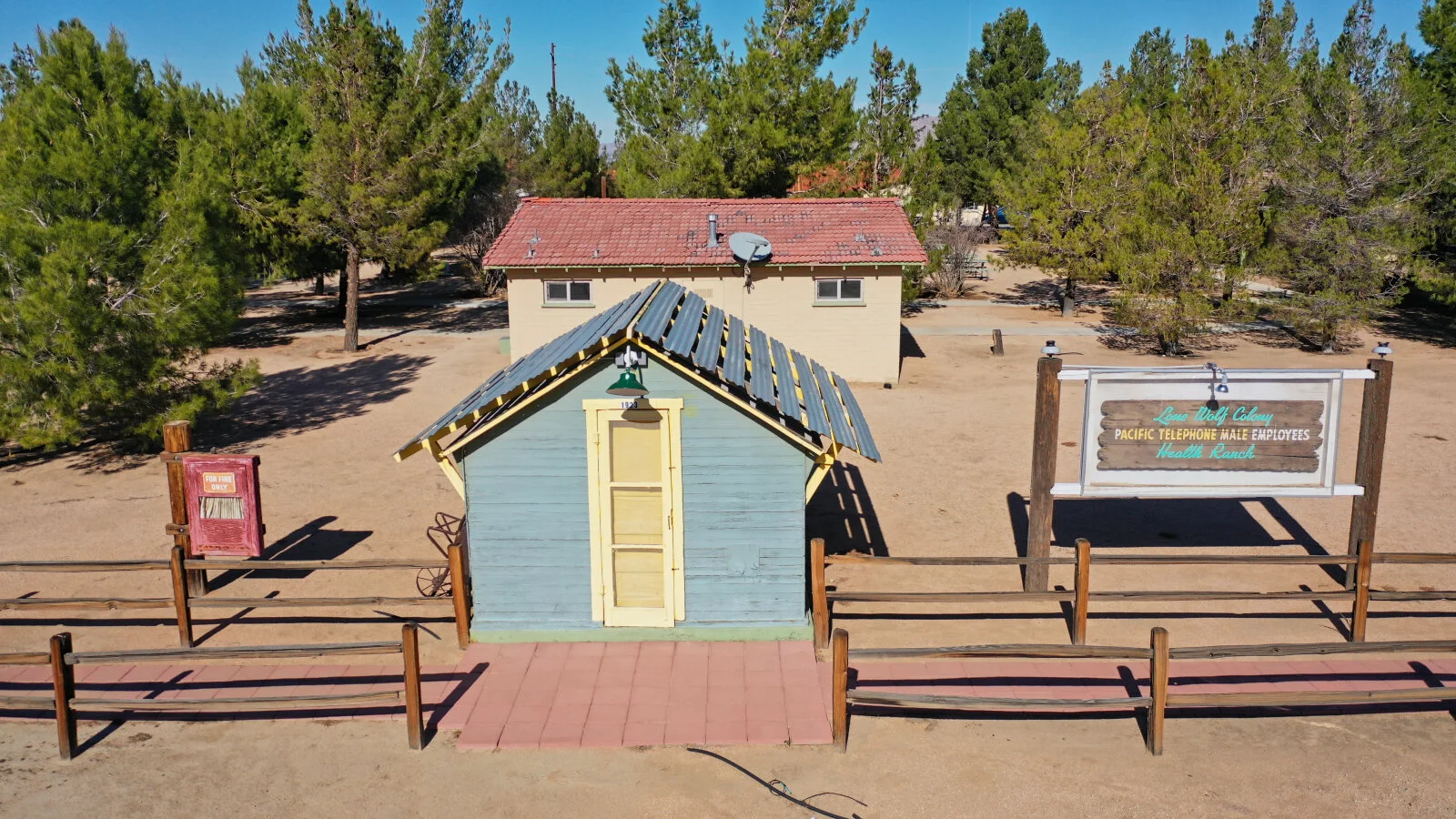
Original Cabin
Lone Wolf Colony continued to grow and gain recognition. Articles published in commercial and telephone industry publications praised its health benefits and distinctive character.
An article in the April 1926 edition of Hollywood Magazine stated:
“Lone Wolf Colony has become one of the most successful of health institutions.”
Despite its continued growth, Lone Wolf Colony remained without telephone service because of its isolated location. On May 5, 1927, the Interstate Telegraph Company, later associated with Verizon, completed a telephone line to the Colony.
One of the historical books about Lone Wolf Colony described the importance of this development:
“Aside from a plentiful supply of water, perhaps no other event in the history of the Colony carried the impact of telephone service. No longer were guests cut off from their families, and the administration of the affairs of the Colony was improved dramatically.”
Lone Wolf Colony was now connected to the outside world.
By 1930, the Colony had accommodations for 10 guests, a permanent caretaker and cook, a mule, goats, chickens, an abundant water supply, and telephone service.
Lone Wolf Colony had come a long way from the small “shack” at its original location.

Financial support has been essential throughout Lone Wolf Colony’s history. Its earliest funds were raised through Spring Smokers held at the American Legion Stadium in Hollywood. The Board continued to hold an annual fundraiser each spring, and the telephone company made regular monthly contributions.
Additional support came from individuals and employee associations within the company. In 1925, telephone operators working with the local operators’ school in Los Angeles raised $325 through activities such as candy sales. At that time, operators were exclusively women, earned approximately $11 per week, and were not eligible to stay at Lone Wolf Colony because it served only men. Their contribution, one of the largest received during that period, demonstrated the employees’ strong commitment to the Colony’s success.
The first contribution from the Southern California Chapter of the Telephone Pioneers of America was only 50 cents. However, the Telephone Pioneers later became one of Lone Wolf Colony’s strongest and most dependable supporters.
Over the years, financial contributions and volunteer labor from Contel, General Telephone, AT&T, telephone-industry associations, and community organizations provided the support needed to maintain and improve Lone Wolf Colony.
Today, the Colony continues to grow and improve with assistance from volunteers representing both telephone-industry and community organizations. Lone Wolf Colony also supports and serves surrounding communities and contributes to projects conducted by a variety of charitable groups.
The organization has grown far beyond Samuel Caldwell’s original vision of a health ranch. He could not have realized that vision without the generosity, cooperation, and dedication of his friends, coworkers, employer, and community.
Throughout its history, many caring and hardworking people have contributed their time, labor, and financial support to make Lone Wolf Colony what it is today. Their collective efforts have created a special place whose history and spirit can still be felt by its visitors and guests.

Lone Wolf Colony 2019